
For the last decade, Search Engine Optimization (SEO) has been dominated by structure. We built our websites like vast, static libraries, strictly organizing content so Google’s crawlers could easily index our volumes of information. Now, ...
 Remington Begg
·
·
5 min read
Remington Begg
·
·
5 min read
For the last decade, Search Engine Optimization (SEO) has been dominated by structure. We built our websites like vast, static libraries, strictly organizing content so Google’s crawlers could easily index our volumes of information. Now, with the rise of AI Overviews and Answer Engine Optimization (AEO), we are moving from a focus on storage structures to retrieval processes.
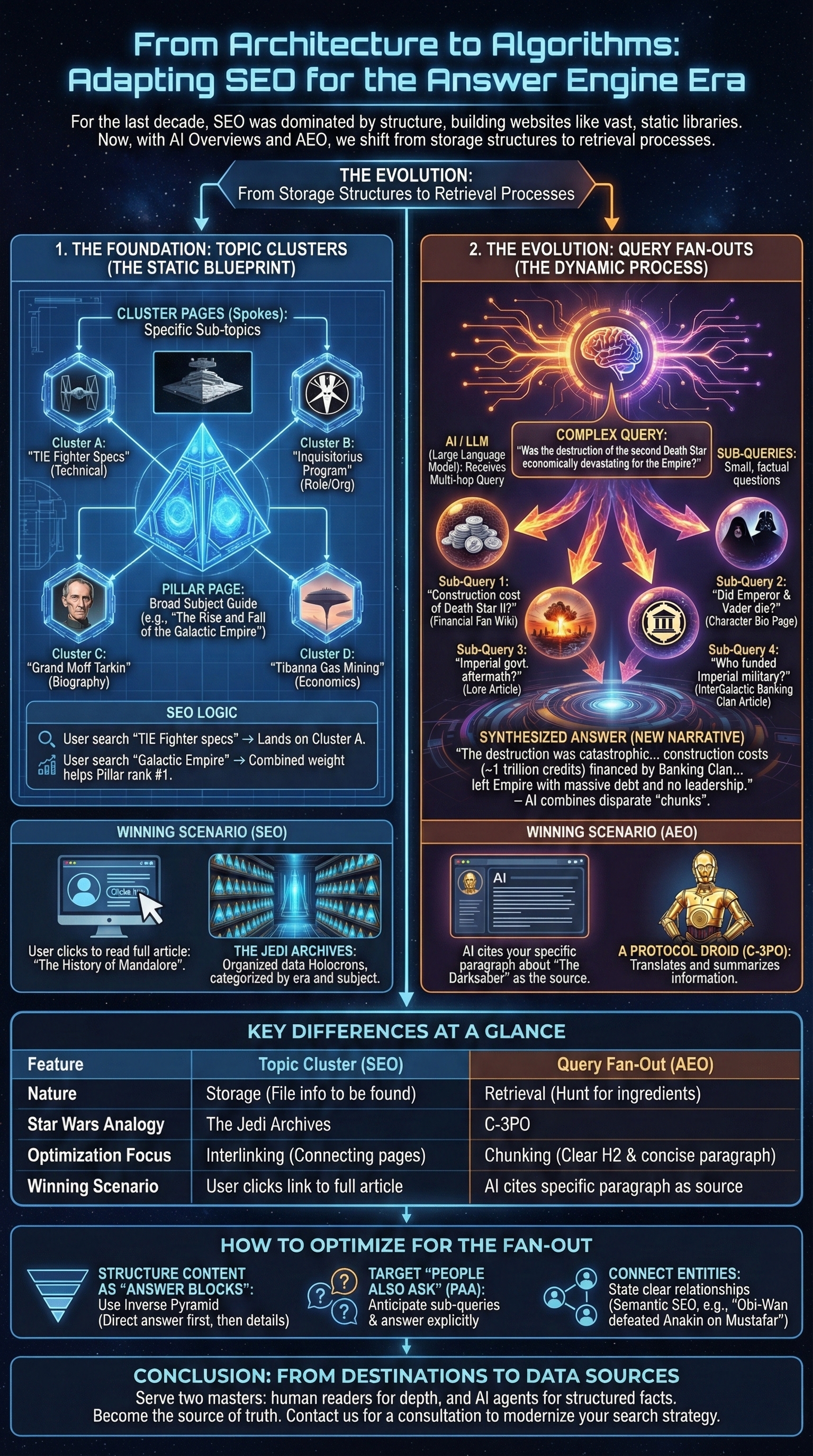
The most critical concept to grasp in this transition is the difference between the Topic Cluster (how you organize content) and the Query Fan-Out (how AI fetches content).
1. The Foundation: Topic Clusters (The Static Blueprint)
A Topic Cluster is an SEO architecture designed to signal authority on a broad subject. It consists of a single "Pillar Page" that covers a main topic at a high level, linked to a surrounding orbit of "Cluster Pages" that cover specific sub-topics in detail.
This structure tells a traditional search engine: "We are the comprehensive source for this entire category."
Star Wars Example: The "Galactic Empire" Cluster
Imagine you run a history site for the galaxy. You want to rank for the broad term "Galactic Empire."
- The Pillar Page: A comprehensive guide titled “The Rise and Fall of the Galactic Empire.” It serves as the broad “table of contents” for the subject, touching on politics, military, and key figures without getting bogged down in minutiae.
- The Cluster Pages (Spokes): These are specific pages linking back to the Pillar:
- Cluster A: "Technical Specifications of the TIE Fighter"
- Cluster B: "The Role of the Inquisitorius Program"
- Cluster C: "Grand Moff Tarkin: Biography and Military Strategy"
- Cluster D: "The Economics of Tibanna Gas Mining on Bespin"
The SEO Logic: If a user searches "TIE Fighter specs," they land on Cluster A. If they search "Galactic Empire," the combined weight of all these clusters helps the Pillar Page rank #1.
2. The Evolution: Query Fan-Outs (The Dynamic Process)
A Query Fan-Out is not a structure you build; it is a process the AI performs. When a user asks a complex question (a "multi-hop query"), the LLM (Large Language Model) does not just look for a page containing those keywords.
Instead, it "fans out" the query, breaking the single complex prompt into multiple, smaller sub-queries. It sends these sub-queries out simultaneously to find specific facts ("chunks") across the web, then reassembles them into a new, unique answer.
Star Wars Example: The Fan-Out Process
The User Query: "Was the destruction of the second Death Star economically devastating for the Empire?"
A traditional search engine might struggle here, looking for a blog post with that exact title. An Answer Engine, however, triggers a Query Fan-Out to construct the answer from scratch.
The Fan-Out Sub-Queries:
The AI instantly generates four distinct search paths:
- Sub-Query 1 (Cost Analysis): "What was the estimated construction cost of the Death Star II?"
Retrieves data from: A financial fan wiki about Imperial Credits. - Sub-Query 2 (Key Figures): "Did the Emperor and Vader die on the second Death Star?"
Retrieves data from: A character biography page. - Sub-Query 3 (Political Aftermath): "What happened to the Imperial government immediately after the Battle of Endor?"
Retrieves data from: A lore article about Operation Cinder. - Sub-Query 4 (Supply Chain): "Who funded the Imperial military machine?"
Retrieves data from: An article on the InterGalactic Banking Clan. - The Result (The Synthesized Answer):
“The destruction of the Death Star II was a catastrophic financial event for the Empire. Beyond the loss of key leadership like Emperor Palpatine, the station's construction costs (estimated at nearly 1 trillion credits) were financed by the InterGalactic Banking Clan. Its destruction left the Empire with massive debt and no leadership to manage the resulting economic collapse.”
The AI combines the disparate “chunks” to create this unique narrative, rather than just linking to a page.
Key Differences at a Glance
|
Feature |
Topic Cluster (SEO) |
Query Fan-Out (AEO) |
|
Nature |
Storage. It is how you file information so it can be found. |
Retrieval. It is how the engine hunts for ingredients to cook an answer. |
|
Star Wars Analogy |
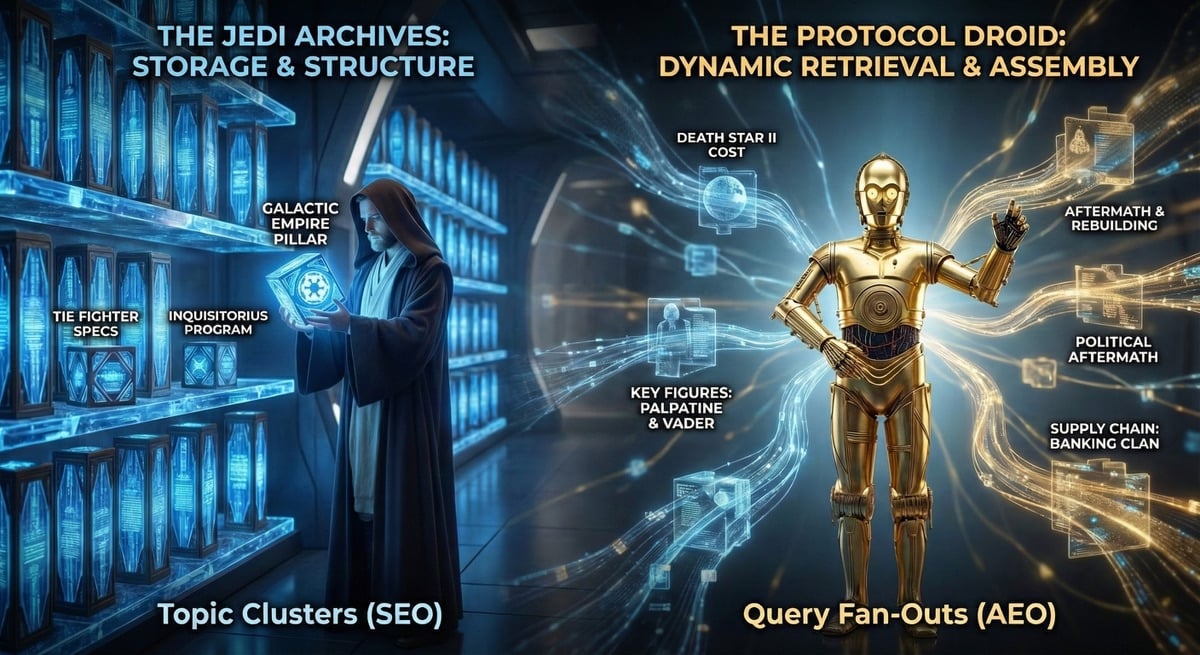
The Jedi Archives. Organized rows of data Holocrons, categorized by era and subject. |
A Protocol Droid (C-3PO). You ask a question, and he accesses millions of forms of communication to translate and summarize the answer for you. |
|
Optimization Focus |
Interlinking. Connecting the "Sith" page to the "Darth Maul" page. |
Chunking. Ensuring the "Darth Maul" page has a clear H2 tag and concise paragraph answering "How did Maul survive Naboo?" |
|
Winning Scenario |
The user clicks a link to read your full article on "The History of Mandalore." |
The AI cites your specific paragraph about "The Darksaber" as the source for part of its answer. |
How to Optimize for the Fan-Out
To succeed in AEO, you must keep your Topic Clusters (they establish authority), but you must refine the content within them to satisfy the Fan-Out.
- Structure Content as "Answer Blocks":
Don’t bury the lead. Use the “Inverse Pyramid” style: start with the direct answer or definition immediately. If you have a page about “Lightsaber Combat Forms,” ensure you have distinct H2s for “Form I,” “Form II,” etc. Under each H2, the first paragraph should be the direct definition. Save the fluff for later. - Target "People Also Ask" (PAA):
The Fan-Out mimics the logic of PAA boxes. If you are writing about "Hyperdrives," anticipate the sub-queries: "How fast is a Class 1 hyperdrive?", "What fuel do hyperdrives use?", "Can you track a ship through hyperspace?" Answer these explicitly.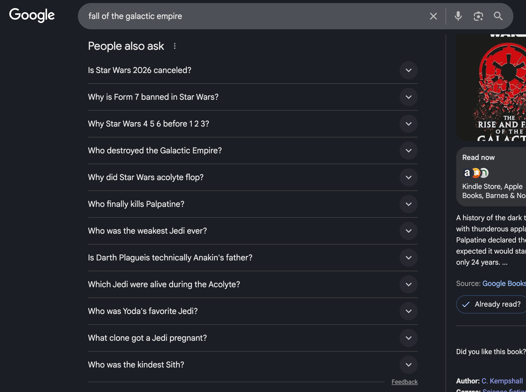
(Pictured: "people also ask" on a google search) - Connect Entities:
AI understands relationships (Semantic SEO). Your content should clearly state relationships between entities.
- Weak Sentence: "He fought him on Mustafar."
- Strong Sentence: “Obi-Wan Kenobi defeated Anakin Skywalker in a duel on the volcanic planet of Mustafar.”
Conclusion: From Destinations to Data Sources
In the traditional SEO model, we focused on building comprehensive destinations (Topic Clusters) where users would land and explore. In the emerging AEO landscape, the focus shifts to building accessible resources that AI agents can easily mine.
Your content needs to serve two masters: the human reader who wants depth, and the AI agent that needs structured, specific facts (Information Chunks) to synthesize answers. Success means your brand is cited as the source of truth in the AI's generated response.
Ready to Modernize Your Search Strategy?
Transitioning from traditional SEO to AEO requires a precise audit of your content architecture. If you need help restructuring your digital marketing to meet modern standards—ensuring you are the answer (not just a link) reach out to our team today for a free consultation & initial audit.