

The age of broad-stroke marketing is officially over. For years, we’ve relied on industry profiles and buyer personas, but in an era dominated by AI and hyper-personalization, that’s no longer enough to cut through the noise. The future of ...
 Remington Begg
·
·
6 min read
Remington Begg
·
·
6 min read
The age of broad-stroke marketing is officially over. For years, we’ve relied on industry profiles and buyer personas, but in an era dominated by AI and hyper-personalization, that’s no longer enough to cut through the noise. The future of a successful go-to-market strategy lies in drilling down to the most specific level: the Ideal Customer Avatar (ICA). By creating ultra-specific content that speaks directly to the unique problems of these individual avatars—not just their job titles—you can shift from a reactive SEO model to a proactive Answer Engine Optimization (AEO) strategy. This is how you win in today's AI-driven landscape, ensuring your message resonates, your content gets surfaced, and your business thrives.
From Broad Strokes to a Fine Point: The Personalization Pyramid
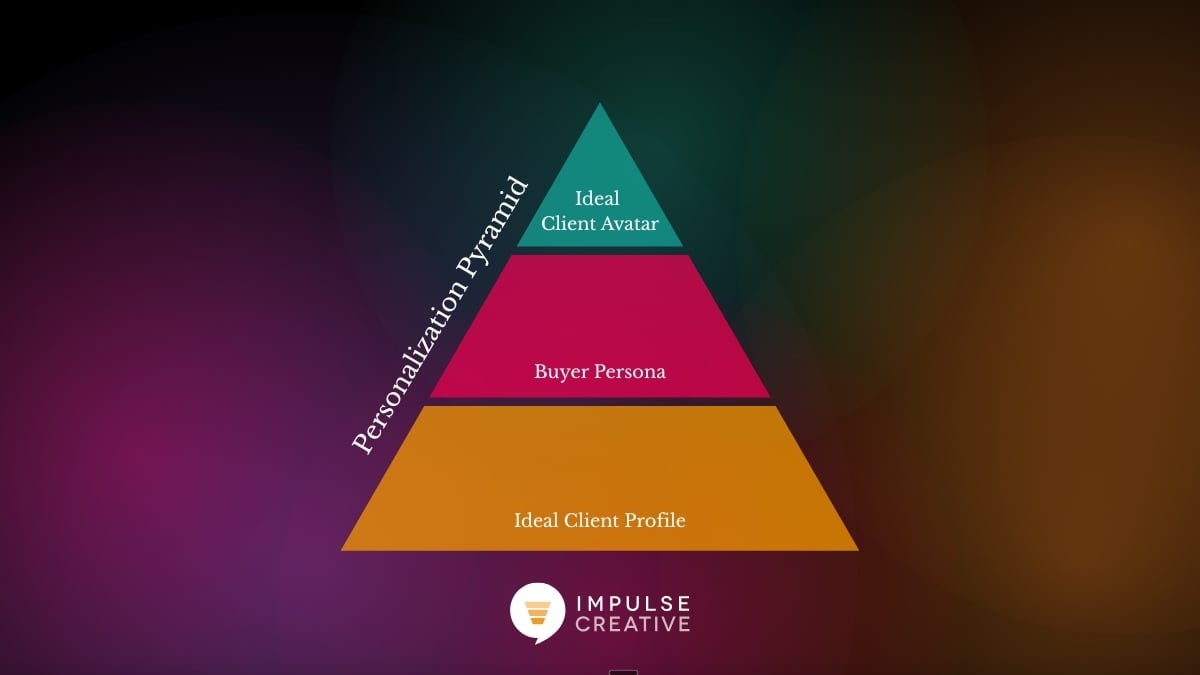
Historically, marketing has been a game of averages. We couldn't create a one-to-one experience for every potential customer, so we settled for grouping them. At Impulse Creative, we visualize this old model as a "Personalization Pyramid."
- The Base - Ideal Client Profiles (ICPs): This is the broadest level. It’s your total addressable market (TAM)—the industries, company sizes, and high-level needs you serve. Think "mid-sized B2B SaaS companies in the fintech space."
- The Middle - Buyer Personas: This is the next level of focus. Here, we group people by seniority or role within those ICPs, like "Marketing Manager" or "VP of Sales." We might segment them as decision-makers or influencers, but it's still a generalization about a group.
- The Peak - Ideal Customer Avatars (ICAs): This is the top of the pyramid and the key to modern marketing. The ICA is the hyper-specific individual within a persona. It’s not just a "Marketing Manager"; it’s "Maria, the Marketing Manager at a 50-person startup who is struggling to prove ROI on her content spend to a data-obsessed CEO."
While personas describe a role, ICAs define a person with a specific, pressing problem they need to solve.
What Exactly is an Ideal Customer Avatar (ICA)?
If you come from a development background, the easiest parallel to an ICA is a user story. But there’s a crucial difference. A user story focuses on what a user wants to do within your product ("As a user, I want to export my report as a CSV"). An Ideal Customer Avatar, on the other hand, focuses on the core business problem they are trying to solve that led them to seek a solution in the first place.
It’s the difference between "wants to export a report" and "needs to present a clear, data-backed report to their board to justify their budget for the next quarter." One is a feature request; the other is a career-defining challenge. When you create content for the challenge, you build a connection that a feature list never could.
Why Now? The AI Era Demands Hyper-Personalization
The reason we can finally focus on the peak of the pyramid is technology. The rise of AI, particularly within platforms like HubSpot, gives us the power to execute hyper-personalization at a scale that was previously unimaginable. If you have a deep understanding of three core things:
- Your own brand (voice, tone, and taste).
- Your buyer personas.
- Your specific Ideal Customer Avatars.
You can leverage AI to create incredibly compelling and engaging conversion opportunities. Your entire go-to-market strategy becomes sharper, more efficient, and drastically more effective because you're no longer shouting into a crowded room; you're whispering the exact right answer into the ear of the person who needs it most.
Winning the 'Zero Moment of Truth': Shifting from SEO to AEO
This focus on ICAs is critical when we consider how the buyer's journey has been transformed by AI. Google's "Zero Moment of Truth" (ZMOT)—that point where a consumer does their research before ever contacting a brand—is happening all over again, but this time it's being mediated by AI Overviews and Large Language Models (LLMs).¹
The old SEO playbook focused on winning broad keywords. But AI is already getting incredibly good at summarizing that top-of-funnel, general-interest content. Soon, those "10 best ways to do X" articles won't even require a click to get an answer.
This is the birth Answer Engine Optimization (AEO).
Search has always been about users entering prompts; they were just dumb prompts met with a list of links. Now, user expectations have shifted. They enter more specific, conversational prompts and expect a direct, intelligent answer. The great news is, if your content is the ultra-specific, valuable resource that perfectly answers that ICA's prompt, it's going to get surfaced. AEO is about creating content for your ICA, not just for a keyword.
Building Your Go-to-Market Engine for the AI Era
So, how do you put this into practice? It requires a strategic shift in how you think about and produce content.
- Embrace Volume and Specificity: You can't speak to Maria the Marketing Manager and David the Sales Director with the same blog post, even if they're in the same persona. This means you’ll need to create 5 to 10 times more content, with each piece laser-focused on a specific ICA-ICP combination.
- Prioritize Freshness: In this new landscape, freshness is a powerful signal to Google and other platforms. If you're consistently publishing hyper-specific, valuable content, search engines will learn to crawl your site more frequently, getting your answers in front of your audience faster. A bi-weekly publishing cadence won't cut it anymore.
- Mine Your Internal Data: The information you need to build your ICAs already exists inside your company. Your customer success and sales teams talk to these people every single day. They know their fears, their frustrations, and the exact language they use to describe their problems. Tap into that goldmine of data.
- Hang Them on the Wall: Once you’ve defined your ICAs, don’t bury them in a folder. Print them out. Give them names. Hang them on the wall so that every person in your organization—from marketing to product to sales—knows exactly who they are working to serve.
The data is there. The tools are there. The opportunity is immense. By understanding and focusing on your Ideal Customer Avatars, you can build a go-to-market engine that doesn't just survive in the AI era—it wins.
The shift to Ideal Customer Avatars is the single biggest opportunity for your go-to-market strategy right now. But defining them can feel like the hardest part. Where do you start? What questions do you ask?

To help you bridge that gap between theory and action, we’ve developed a new tool to accelerate the process. Try our new ICA Builder Agent today. It’s designed to guide you through the discovery process, Helping you build upon your ideal client profiles and buyer personas to create content resonates with your ICAs.