

The role of corporate education has fundamentally changed. It's no longer a cost center but a primary engine for go-to-market (GTM) success. A modern academy, built on a CRM-native platform, is a strategic opportunity for lead generation, ...
 Remington Begg
·
·
6 min read
Remington Begg
·
·
6 min read
The role of corporate education has fundamentally changed. It's no longer a cost center but a primary engine for go-to-market (GTM) success. A modern academy, built on a CRM-native platform, is a strategic opportunity for lead generation, sales acceleration, and customer retention. By embedding learning data directly into your customer's CRM record, you create a virtuous cycle of engagement that builds a durable competitive moat and delivers a measurable return on investment (ROI) across the entire customer lifecycle. This is the blueprint for harnessing education-led growth.
From Cost Center to Growth Engine
Historically, corporate learning has been a cost center, focused on internal compliance and onboarding. This inwardly focused model is insufficient in a modern business environment. The contemporary Corporate Academy is a paradigm shift—an intentional educational initiative designed to educate customers, partners, and the broader market to drive top-line business results.
This evolution gives rise to Education-Led Growth, a model where the academy becomes the central hub for creating a robust ecosystem around the business. Organizations that embrace this model move beyond teaching users how to use a product; they teach them why it matters, embedding their methodology into the fabric of their industry. This transforms the academy from an expense into a powerful engine for sustainable growth. Need Proof? Consider HubSpot's own Academy as a masterclass in Education-Led Growth.
The Four Pillars of an Academy Ecosystem
A strategic academy serves four distinct yet interconnected audiences. Developing all four in concert creates a self-reinforcing GTM flywheel.
-
Customer Academy: The most common starting point, this pillar focuses on the post-sale journey. Its primary goal is to accelerate onboarding, drive product adoption, reduce churn, and ultimately increase Customer Lifetime Value (CLV).
-
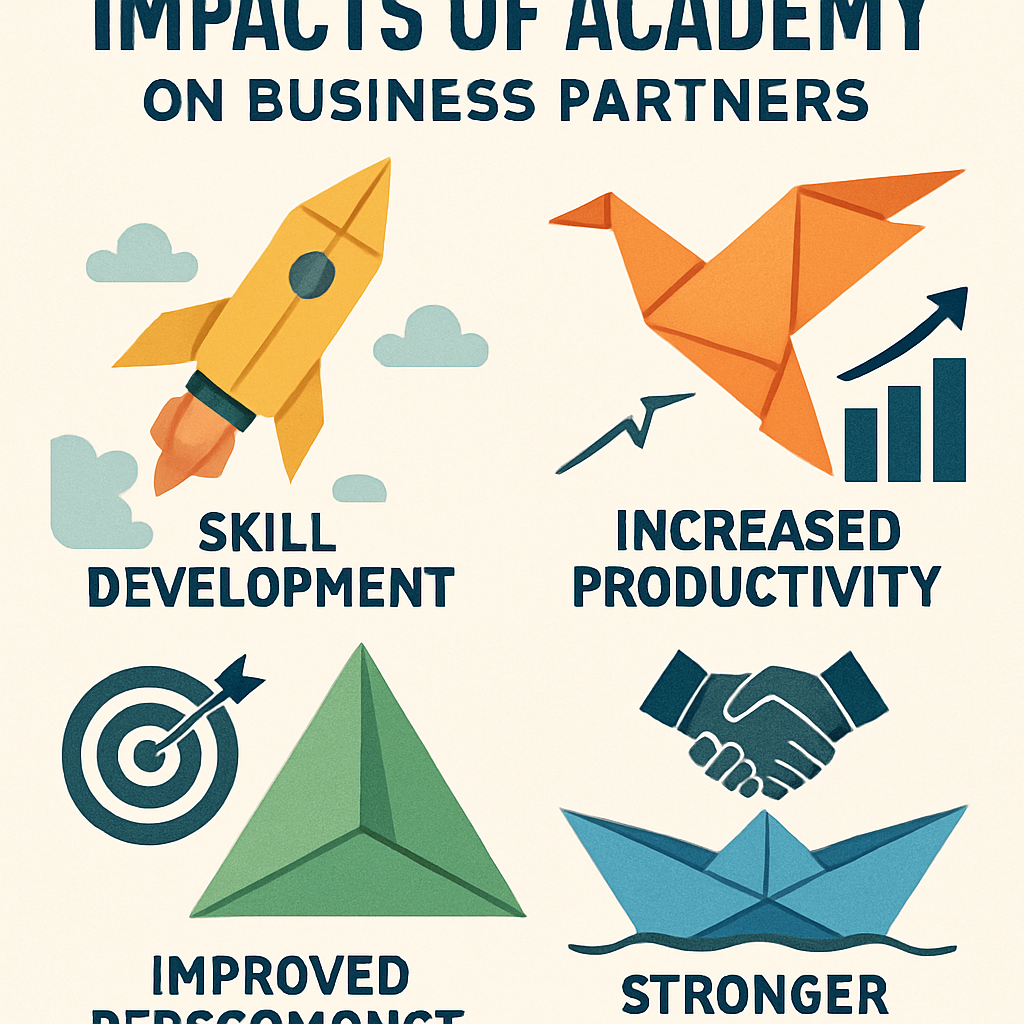
Partner Academy: For businesses with channel sales, this pillar scalably trains and certifies the entire partner network. A well-educated partner channel leads directly to increased sales, improved market ownership, and a more consistent customer experience.
-
Employee Academy: This is the bedrock of internal GTM alignment. It provides a single source of truth for product updates, competitive positioning, and company messaging, ensuring every customer interaction is consistent and informed. Strong employee training is a powerful driver of performance and talent retention.
-
Market Academy: The most ambitious pillar, this offers education to the entire industry, not just paying customers. By providing high-value courses and certifications, a company can define its category, control the narrative, and build unparalleled brand credibility. This strategy turns the educational platform into a powerful top-of-funnel marketing engine, creating a continuous pipeline of highly qualified, educated leads.
The Technology Linchpin: Why CRM-Native Matters
The vision of education-led growth is only possible with a technology foundation that eliminates data silos. A standalone LMS separates learning metrics from the core customer record, making true ROI calculation nearly impossible. A CRM-native LMS, built directly within a platform like HubSpot, solves this fundamental problem.
Because all learning activity—course enrollment, quiz scores, certifications—is captured directly on a contact's record, a single, unified source of truth is created. This unified data model is the linchpin that allows an academy to become an intelligent growth engine.
-
Personalized Learning Paths: Access to content can be automated based on CRM data. A customer who adopts a specific feature can be automatically enrolled in an advanced course. A prospect from a target industry can be given access to a relevant case study module. This ensures each learner receives the right content at the right time.
-
Full-Funnel Reporting: Education KPIs can be added directly to any CRM dashboard. This allows leadership to visualize the direct correlation between course completions and core business metrics like lead-to-customer conversion rates, churn rates, and expansion revenue.
-
Automated Cross-Functional Workflows: Learning data becomes a trigger for action across the business. A prospect completing a course can be added to a marketing nurture campaign. A customer finishing an onboarding module can trigger a task for their Customer Success Manager. The LMS becomes an intelligence-gathering platform that makes every team smarter.
-
AI-Powered Teaching Assistant: The unified data provides the perfect foundation for an AI agent. This assistant can proactively engage learners, answer context-specific questions, and guide them toward content that aligns with their needs and your business goals, scaling personalized education at an unprecedented level.
Is this getting you thinking? That's why we built HubLMS.com. We saw firsthand how disconnected systems and data silos prevented businesses from realizing the true strategic value of education. We built HubLMS as a HubSpot-native platform to solve this exact problem — to transform corporate learning from a cost center into a measurable, data-driven engine for growth.

Supercharging the Go-to-Market Flywheel
When powered by a CRM-native LMS, a four-pillar academy systematically reduces friction and drives measurable improvements across the entire customer journey.
-
Lead Generation: A market academy transforms educational content into a strategic top-of-funnel engine. Free courses and certifications act as high-value lead magnets, attracting a more motivated audience and lowering Customer Acquisition Cost (CAC).
-
Sales Acceleration: Providing prospects with educational resources creates a more informed and confident buyer, leading to a faster sales process. For channel models, a partner academy is the most efficient way to onboard and enable a distributed sales network, ensuring message consistency and effectiveness.
-
Customer Retention: A structured onboarding program drastically reduces Time-to-Value (TTV), mitigating early-stage churn. A comprehensive knowledge base deflects support tickets, lowering operational costs. By continuously educating customers on advanced features, the academy creates a direct link to expansion revenue, a key driver of Net Revenue Retention (NRR).
A Framework for Measuring Academy ROI
To be treated as a strategic asset, an academy's contribution must be quantified. The GEAR framework provides a clear model for measuring business impact beyond vanity metrics.
-
Growth Efficiency: Cost savings from reduced support tickets and faster onboarding.
-
Expansion: New revenue from upsells and cross-sells influenced by education.
-
Advocacy: Increases in Net Promoter Score (NPS) and customer referrals.
-
Retention: Reduction in customer churn and increases in CLV.
Calculating Financial Impact:
The connection between education and financial results can be calculated with straightforward formulas:
-
Support Cost Savings:
(Estimated Tickets Deflected) x (Avg. Cost Per Ticket) = Total Savings -
Revenue Impact from Retention:
(Number of Customers) x (ACV) x (Retention Lift %) = Potential Retained Revenue
Industry benchmarks from firms like Forrester show that companies with established customer education programs see a 6.2% increase in revenue and a 7.4% increase in customer retention.
Strategic Implementation Roadmap
A successful launch requires a phased approach focused on solving a core business problem first.
-
Phase 1: Define the Strategic Focus (First 90 Days): Start with a narrow, measurable goal. For most, this is improving customer onboarding to reduce early churn. Define the target learner persona and the "first win" moment they need to experience.
-
Phase 2: Build the Foundation: Audit existing content that can be repurposed. Select a CRM-native technology stack (Like HubLMS) to avoid creating data silos that will need to be fixed later.
-
Phase 3: Launch and Iterate: Develop a multi-channel plan to promote the academy internally and externally. Continuously monitor engagement data to refine and improve content.
-
Phase 4: Scale the Ecosystem: Once the initial program shows clear ROI, expand to the other three pillars—Partners, the Market, and Employees—to build a comprehensive learning ecosystem and a durable competitive advantage.
