

Information discovery is undergoing a fundamental and rapid transformation. For business leaders and marketing managers, the "browser wars" are no longer about market share between Chrome and Firefox; they're about the battle for customer ...
 Remington Begg
·
·
8 min read
Remington Begg
·
·
8 min read

Information discovery is undergoing a fundamental and rapid transformation. For business leaders and marketing managers, the "browser wars" are no longer about market share between Chrome and Firefox; they're about the battle for customer attention being waged by a new generation of sophisticated AI agents, think ChatGPT Atlas Browser, Perplexity’s Comet browser, and even Gemini & Google Lens within Google Chrome.
These agentic browsers are not a change that’s coming; they're already here, fundamentally reshaping how users find, evaluate, and ultimately buy your products and services. The core reality is this: humans are built on the pursuit of efficiency, seeking the most value with the least amount of effort. This drive is leading them to put more trust in instant, personalized LLM-generated summaries than in a company's own marketing copy.This shift presents both an existential threat and a massive, time-sensitive opportunity.
The New Buying Influence: AI Agents and Memory
The most significant change is the introduction of a new buying influence: the AI agent assisting the customer.
These agents don't just provide search results; they offer real-time, ultra-detailed summaries and consensus on your company, products, and services, often pulled directly from your web pages. Even more critically, the memory features in platforms like ChatGPT are creating a hyper-personalized, passive historical context for every user.
-
Inferred Intent: A user doesn't have to explicitly state their company's tech stack or budget constraints. The AI infers this context, from past conversations about troubleshooting, job descriptions, or even communication styles, to influence the recommendations it provides for business-related inquiries.
-
The Competitor Sidebar Threat: If a user is viewing your website and asks a question about your page, the agentic browser, especially through its sidebar, may serve up information from your competitors if their content is more specific and relevant to that exact persona and pain point. It can even surface comparative analyses that your competitor already has on their site, right when the user is viewing your service page.
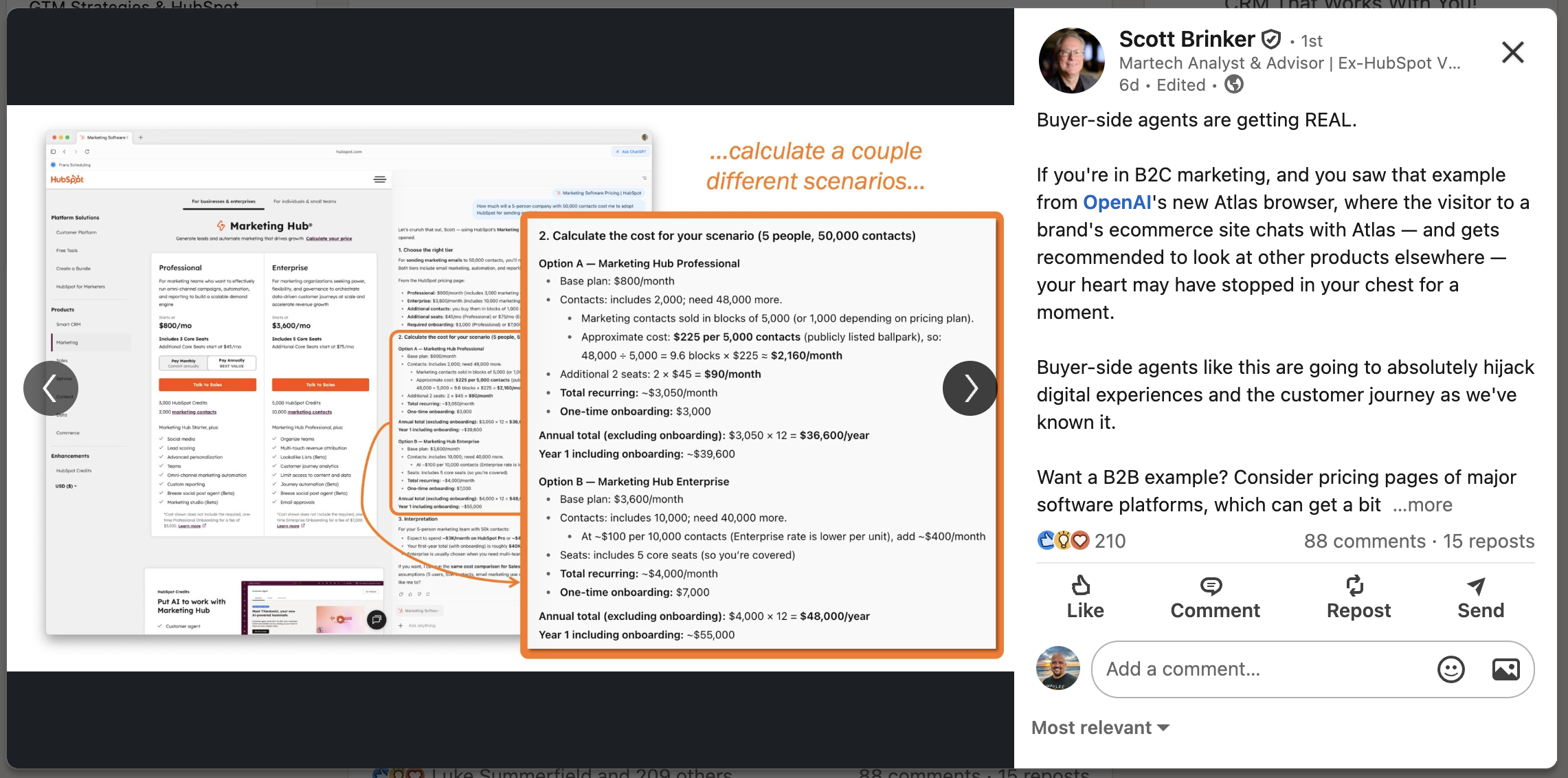
This means if your website merely lists features, your competitors will define the context, and ultimately, the choice, for the customer.
Content is More Important Than Ever, But Not as You Know It
The narrative that marketing or SEO is "dead" couldn't be further from the truth. In this new era of AEO (Answer Engine Optimization), your content is arguably ten times more important than it has ever been. However, its purpose and structure must change immediately.
Leaders must move beyond high-level buyer personas and build content for ultra-specific Ideal Client Avatars (ICAs). This is a few steps deeper than a traditional buyer persona. This means developing content that is more evenly distributed through the funnel and is segmented not just by industry, but by:
-
Specific Pain Points
-
The User's Role (Functional Process)
-
Tangible Outcomes they should achieve using your product or service.
The focus must be on creating deep, bottom-of-the-funnel content for these ICAs. For example, product pages should go far beyond "Product X for Manufacturing".
The goal is to serve the highly-specific, relevant information first, before the agent can look elsewhere. This can be accelerated by leveraging tools like smart content, segmentation, and personalized user journeys available in platforms like HubSpot, but the foundation is the content itself.
Structural Imperatives: Alignment, Accessibility, and Consistency
Winning in the AI agent era requires a fundamental pivot in website structure, focusing on how information is organized and consumed by both humans and machines.
1. Content Structure and Segmentation:
The entire website structure must be built to support the ICA content strategy. This means:
-
Deep Site Architecture: Move away from flat, shallow navigation. Create hierarchical content clusters that map directly to the ICA needs and the funnel stage.
-
Smart Content Implementation: Use smart content and segmentation tools to dynamically change the content displayed based on what you already know about the user (their role, industry, previous site behavior). This provides the ultimate in relevance, which is the core combat strategy against the sidebar competitor threat.
-
Next-Step Questions (Internal Linking): Every piece of content should anticipate the user's next logical question and provide a clear, easy-to-follow link to the corresponding, more detailed content further down the funnel. This ensures the agent is fed a complete, company-controlled journey.
2. Consistency and Alignment (The 'A' in CLEAR):
Just as "Name, Address, Phone Number" consistency was vital for local SEO, brand consistency is critical for AEO.
-
Omni-Channel Alignment: How you talk about your brand, services, and products must be identical across your website, social profiles, third-party review sites, and business listings. Agents are designed to synthesize consensus; any inconsistency is a point of confusion they will flag, potentially weakening your credibility.
-
Reviews Integration: Your website needs to natively display and integrate reviews from external sources. Furthermore, business leaders must ensure that their company has answered every review across all platforms. This demonstrates transparency and control over your narrative, both crucial for agents assessing your company.
- Authentic Comparisons: Your website needs to compare your product or service up against competitors. If you don't have content that reinforces this, then you're letting the sidebar creep up with your competition's comparison.
3. Accessibility:
An accessible website is not just a regulatory requirement; it is a structural necessity for optimal AEO.
-
Clear Tagging and Labeling: Ensure all images, videos, and interactive elements are properly tagged with descriptive alt text and captions. LLMs and agents rely on this context to understand and summarize rich media content.
-
Structured Data: Implement schema markup across all relevant pages (products, services, FAQs, reviews). This is how you explicitly tell the AI agents what your content means, guaranteeing the information is correctly interpreted and summarized.
- Deeper "next stage question" FAQ's: Each page should leverage FAQ's (with the schema and structured data too) to answer not just the question that the page answers, but the next 2 levels deeper of questions that your prospects will have.
Your New AEO Foundation: The CLEAR Framework
To compete and win in the AI era, your digital presence must become more detailed, descriptive, and transparent than any of your competitors. When re-architecting your website, business leaders must ensure every page is built on a foundation of trust and specificity. For a systematic, page-by-page guide, reference the CLEAR framework at clearframework.ai (a resource you can consult for detailed steps).
| Element | Focus Area | Strategic Imperative for AEO |
|
C - Credibility & Clarity |
Trust signals, unique positioning, and transparent communication. |
Provide a consistent, omni-channel narrative. Ensure reviews (and your answers to them) are natively and prominently displayed on your site to establish authority. |
|
L - Leverage & Logic |
The cost-benefit analysis and the functional process for the user. |
Justify the cost-versus-benefit. Explain how your product solves a problem from a functional process standpoint, not just what it is. |
|
E - Evidence & Emotion |
Customer stories, social proof, and addressing the user's pain/gain. |
Directly address the specific pains of your Ideal Client Avatars and the tangible gains (outcomes) your product delivers. |
|
A - Alignment & Accessibility |
Consistency, structure, and technical readability. |
Align brand messaging everywhere. Ensure technical accessibility (schema, alt-text) so AI agents can fully read and accurately summarize your content. |
|
R - Responsiveness & Relevance |
User experience, speed, and next-step actions. |
Ensure your content anticipates and answers every logical next-step question a user might have. Leverage smart content to segment and customize the on-page experience for maximum relevance. |
Your Website in 2026: Re-Architecture, Not Just Redesign
As you plan for 2026, understand that the goal isn't necessarily a costly, top-to-bottom aesthetic redesign. The critical mandate is a strategic re-architecture of your entire digital presence. This shift requires integrating your marketing and sales assets into a unified "Revenue Engine" designed for both human conversion and AI consumption.
Here are the core components of a strong, AI-ready website re-architecture:
1. An Integrated Foundation For Your Omni-Channel Strategy:
Stop treating your website like a static, digital brochure. A strong website must be the integrated hub of your entire Go-To-Market strategy.
-
CRM Integration: The website must be seamlessly connected with your core business systems (e.g., your CRM and automation platforms). This eliminates data silos and manual processes that hinder scaling.
-
Conversion Engine: The platform needs to be engineered to turn anonymous traffic into a predictable pipeline of qualified leads, with full-funnel tracking and analytics implemented to prove marketing's direct impact on revenue.
2. Unified Customer Experience (CX) Platforms:
The modern customer journey doesn't end at the sale; it extends through retention and advocacy.
-
Post-Sale Digitization: Digitize key customer touchpoints like onboarding, support, and account management. If your sleek marketing site is disconnected from a clunky post-sale experience, that friction costs you relationships.
-
Customer Portals: The ultimate re-architecture involves transforming your site into a unified CX platform with seamless customer portals (knowledge bases, support ticketing, account access). This increases satisfaction, boosts retention, and turns customers into advocates by managing a single, seamless experience from prospect to advocate.
By prioritizing this re-architecture, ensuring your content structure supports ultra-specific ICAs and your technical foundation is integrated and engineered for AI agents, you ensure that your overall user experience and structural functionality are in tip-top shape to compete and grow.