

When leadership asks, "How are we using AI?", a list of tools won't cut it. The only strategic answer is a plan rooted in a clear framework. This guide provides one, helping you evaluate AI opportunities based on two simple axes: your ...
 Remington Begg
·
·
5 min read
Remington Begg
·
·
5 min read
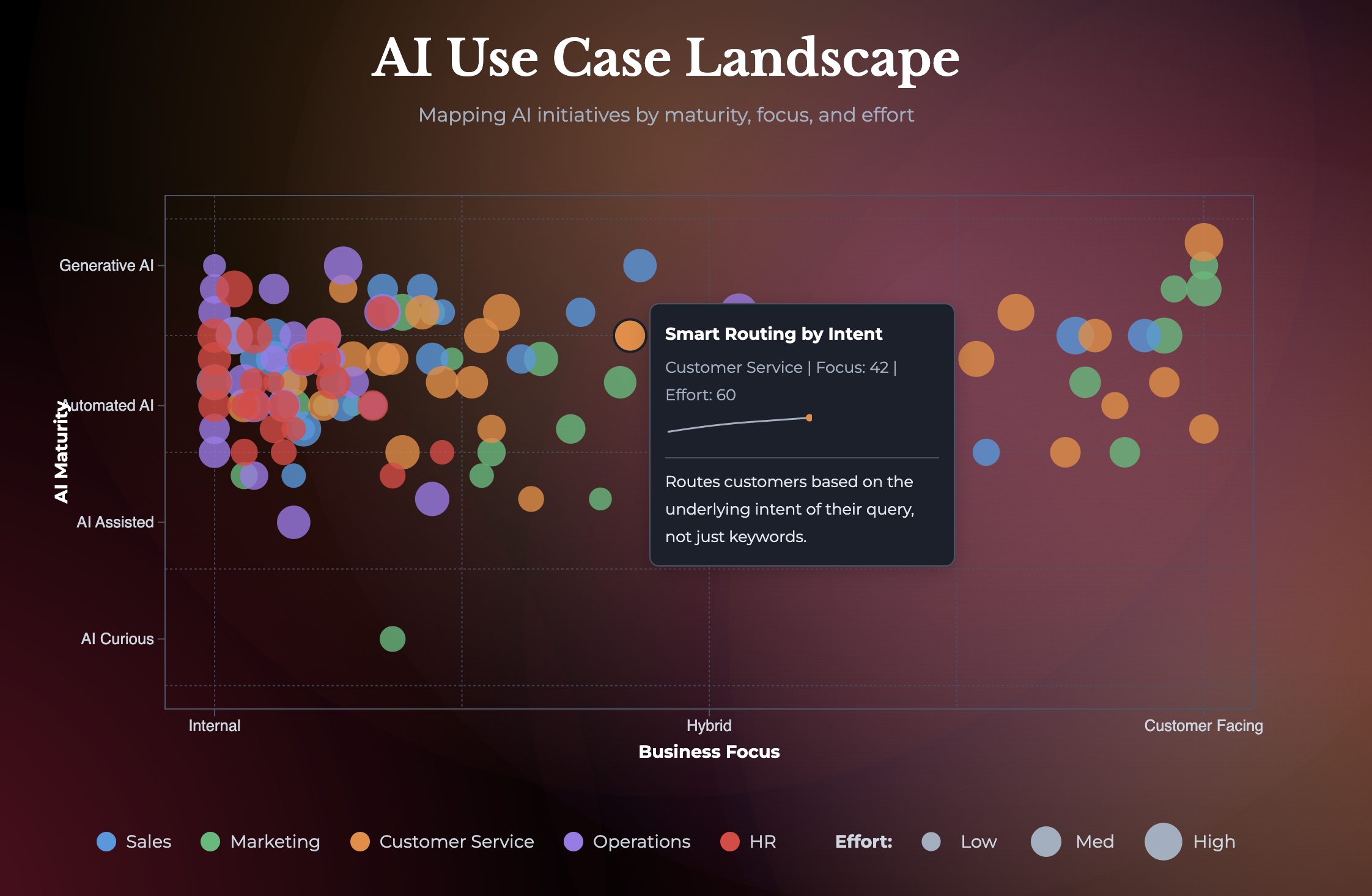
When leadership asks, "How are we using AI?", a list of tools won't cut it. The only strategic answer is a plan rooted in a clear framework. This guide provides one, helping you evaluate AI opportunities based on two simple axes: your organization's current AI maturity and a project's proximity to your customer. This approach moves you from reactive answers to a proactive, risk-aware AI roadmap.
Start by Asking Better Questions
A strategic conversation about AI begins with asking the right questions—whether you're the one asking or the one being asked.
For Leaders: Asking More Effective AI Questions
The quality of the answer you get depends on the quality of your question. Instead of the broad "How are we using AI?", try asking more specific questions based on where your organization is today.
-
If Your Team is AI Curious: "What are the top three opportunities where better data access and summarization could save our team significant time this quarter?"
-
If Your Team is AI Assisted: "Which of our high-volume, repetitive internal processes are the best candidates for automation to free up our team for more strategic work?"
-
If Your Team is Exploring AI Automation: "Based on our current automated workflows, what is the next strategic, customer-facing process we could transform, and what are the known risks and data requirements?"
For Managers & Teams: Clarifying the Vague AI Question
When the question does come, don't guess what your boss means. Ask clarifying questions to get the context you need. Better yet, use our accompanying AI Idea Worksheet to proactively prepare your strategic ideas before you're even asked.
-
To Clarify Business Area: "That's a great question. To give you the most relevant answer, could you clarify which area you're most interested in—for example, operational efficiency, marketing, or customer experience?"
-
To Clarify Risk & Scope: "Are you thinking about immediate, low-risk 'power-ups' for our team, or are you envisioning bigger, long-term automation projects?"
-
To Clarify Goals: "To help frame my answer, what would a successful AI initiative look like to you in the next six months?"
A Strategic Framework: The Two Axes of AI Implementation
To develop a clear, risk-aware roadmap, every potential AI project should be evaluated against two key dimensions: your organization's AI Maturity and the project's Proximity to the Customer.
Axis 1: The AI Maturity Model
Most organizations want to jump straight to fully autonomous systems, but this often leads to failure. It’s critical to be honest about where you are on the spectrum.
-
Level 1: AI Curious At this stage, individuals may be exploring public tools like ChatGPT, but there's no formal strategy, policy, or secure data foundation. The primary goal here is to Establish a Foundation by focusing on data security, internal policies, and acceptable use guidelines. The risk is low but so is the organizational impact.
-
Level 2: AI Assisted Here, AI is used for augmentation. It supports human tasks by summarizing, drafting, or analyzing data. The goal is to Empower the Team with quick wins that act as a "power-up," making them more efficient. This is a moderate-risk stage, as a human is always in the loop.
-
Level 3: AI Automated At this level, AI executes clearly defined, repeatable tasks with minimal human oversight. The focus is to Streamline Operations, especially high-volume, low-complexity workflows. The risk becomes high, requiring clean data and robust governance.
-
Level 4: Agentic AI This is the most advanced stage, where AI autonomously manages complex, multi-step workflows, adapting and making independent decisions. The goal is to Transform the Business by tackling high-value processes. The risk is very high and only suitable for organizations with deep data maturity.
Key Takeaway: Most teams today are AI Curious or AI Assisted. You must master the foundational levels before attempting high-risk automation.
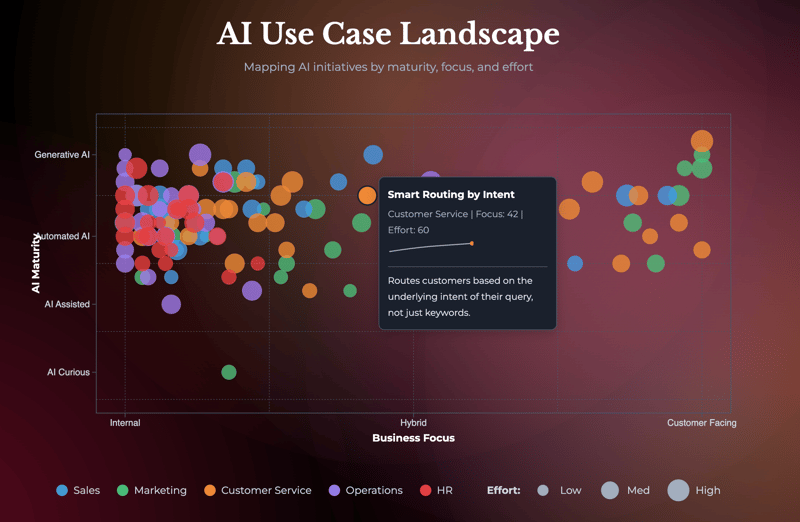
Axis 2: Proximity to the Customer
The second axis to consider is how close the AI initiative is to your customers. This is a simple but powerful way to manage risk.
-
Internal Initiatives: These projects are focused on employees, operations, and internal data (e.g., summarizing sales call transcripts for training). They provide a safe testing ground to refine models and catch mistakes.
-
Customer-Facing Initiatives: These are projects where AI directly interacts with or impacts the customer experience (e.g., a public support chatbot). These carry higher brand risk.
Strategic Recommendation: Start with AI Assisted, Internal projects. They offer an immediate "power up" to your team without the risk of an "AI hallucination" going public.
Your Foundational Checklist Before You Start
The market is full of tools selling effortless automation. True AI empowerment requires foundational work first.
1. Establish Your Data Foundation
A strategy is only as good as its data. This means centralizing your data out of scattered silos and implementing processes to ensure its quality and accuracy.
2. Create Policies and Procedures
Before your team starts using AI, you need an operating agreement. This includes an Acceptable Use Policy (defining approved tools and data usage) and a Brand Voice & Tone Guide so any content-generating AI sounds like your brand.
3. Shift the Mindset: Power-Up, Not Shortcut
View AI as a "Power-Up" that augments the talent of your team, making them faster and more capable. A "Shortcut" mindset encourages skipping foundational work, which is the fastest route to a failed project.
Ready to Go from AI Curious to AI Empowered?
This framework is your starting point. Building a true AI-powered organization requires a dedicated strategy.
A Word of Caution: Choosing the Right AI Partner
As you explore AI consulting, be wary of agencies that lead with a specific AI tool or platform. True AI empowerment isn't about force-fitting your business into a single piece of AI software. A strategic partner should be platform-agnostic, focusing first on understanding your business, your data, your security policies, and your customers. The strategy must come before the tools.
Ready to build your roadmap?
Reach out to Impulse Creative to schedule a Strategic AI Workshop. We'll guide your team through this framework to create an actionable plan that transforms your business.